In today’s rapidly evolving world, knowledge is the key to success. It is inside this knowledge that we can find the insights, lessons, guidance and experiences that we need to move forward and accelerate change. Having said, we live in a world with an information overload, and frankly the most valuable knowledge often remains inside the heads of the professionals. This is because the knowledge product either stays too much on the surface, or knowledge producers write in the style “look at what I want to tell you”, instead of providing the information that “the reader needs to enable effective action”.
Treasure hunting is needed to develop knowledge products
Knowledge products are designed to share knowledge, educate, or provide valuable information to individuals, organizations or the public. But above all, the knowledge product should “enable effective action by the reader / intended user” (i.e. public, private, development, or non governmental) [1]
“knowledge is our treasure, but we need to hunt it down”
This means that the knowledge producer needs to go treasure hunting themselves. Having done research for WaterAid to develop their knowledge product templates, I found that knowledge producers should do three things before starting:
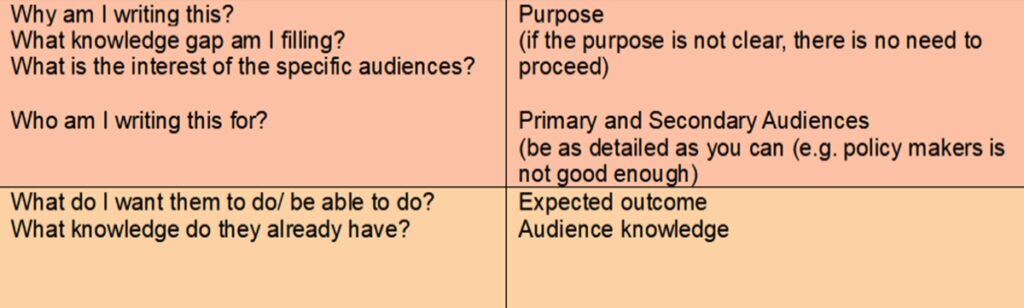
1. Hunt down the purpose audiences and expected outcomes
There are a series of key questions that are essential to ask yourself before you are developing the knowledge product (the darker ones need to be answered first)
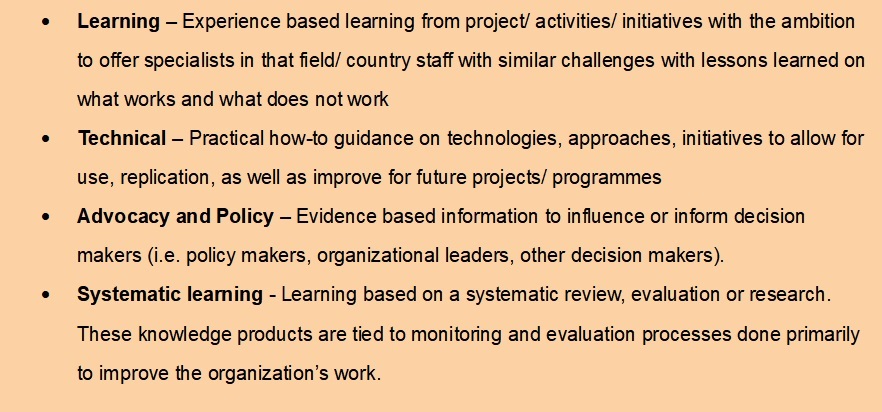
2. Decide on the type of treasure you have in your hands
Using the expected outcome together with your purpose should allow you to decide which of the four types of treasures (categories of knowledge) you have.
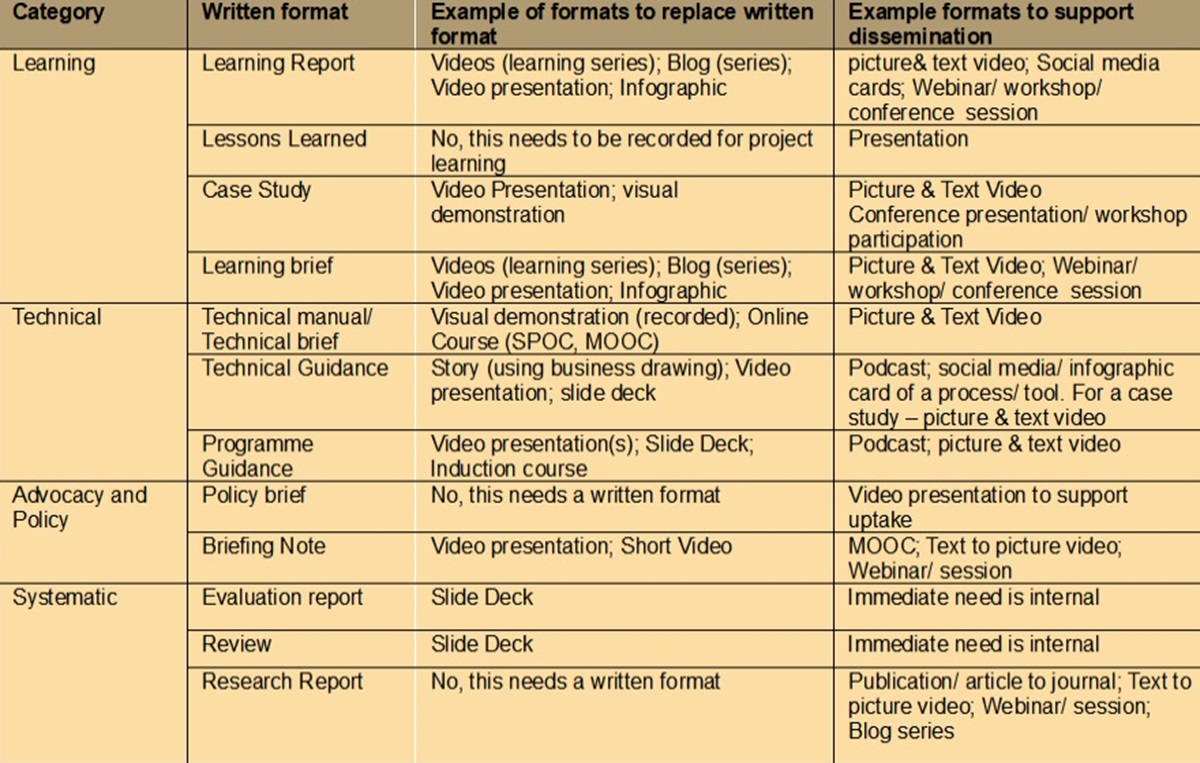
3.Deciding on the vehicles to move the treasure to its user
Knowledge products used to only be only in the form of reports. And whilst a report provides you with the space to capture the details you may want to convey for the reader to take effective action, it is no longer the only (or preferred) vehicle for its user.
The existing information overload requires knowledge users to more quickly scan the available information for relevance. And the wider availability in formats has allowed knowledge users to create new preferred vehicles to obtain knowledge.
Therefore, a knowledge producer should understand their audiences and either:
- Start with a written report capturing the details, and ensure that there is an effective dissemination plan which contains multiple formats (e.g. infographic, a short video, a picture video, a social media card etc etc etc.) for different audiences to ensure that the key messages are shared and linked back to the report OR
- Produce one or multiple formats in the formats that could replace the written format – and produce a series that does ensure that you capture the “how to” of the story (e.g. video series, blog series, drawing series, etc etc etc.) and think through the formats for the diverse audiences.
The knowledge producer should always develop an effective dissemination plan in which multiple formats, as per table below, can be used to reach its audiences.
4.Viewing the treasure from under a magnifying glass
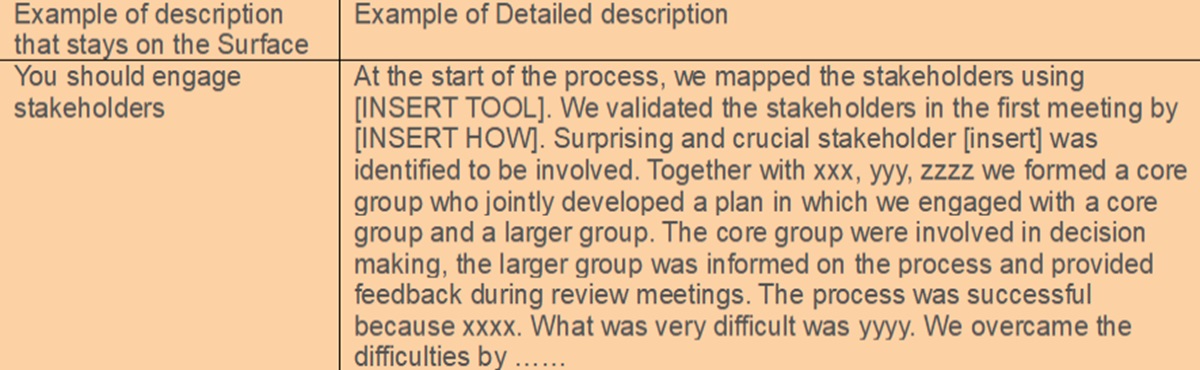
To enable the knowledge user to take action based on your product, requires a description of the step-by-step approach you took (or what you want audience to take). It means you should refrain from staying too much on the surface and provide the details to your audience. Here is an example to illustrate the difference.
Want to get started?
We can discuss your needs, your interests, your audiences, and I can guide your organization in deciding on the knowledge products and formats for the correct audience, produce templates with useful guiding questions that support you in ensuring you are diving into the depth required. Additionally, I can guide your staff in using these materials, and or design a learning session for them.
If you are interested reach out to me.
[1] https://www.nickmilton.com/2018/01/what-is-knowledge-product.html
_____________________________________________________________________________________________________________________________________________________________________________
About the author: Kirsten de Vette, owner of this website, and independent consultant and facilitator working in water, sanitation, and hygiene (related) sectors for over 14.5 years. I am a sociologist with business background who connects people, facilitates knowledge and expertise exchange, facilitates partnerships, collaboration and or change processes and facilitates capacity assessment/ development. My expertise is in capacity development, stakeholder engagement & facilitation of change processes and learning.